CLP-SNN: online continual learning co-designed with Intel Loihi 2
A spiking version of CLP, co-designed with neuromorphic silicon, that learns new classes from a data stream on the chip itself, without replay buffers or backpropagation.
- 7.3×lower latency than Replay on Jetson Orin Nano
- 341×lower energy, at comparable accuracy
- 0.33 msper prediction-and-update step
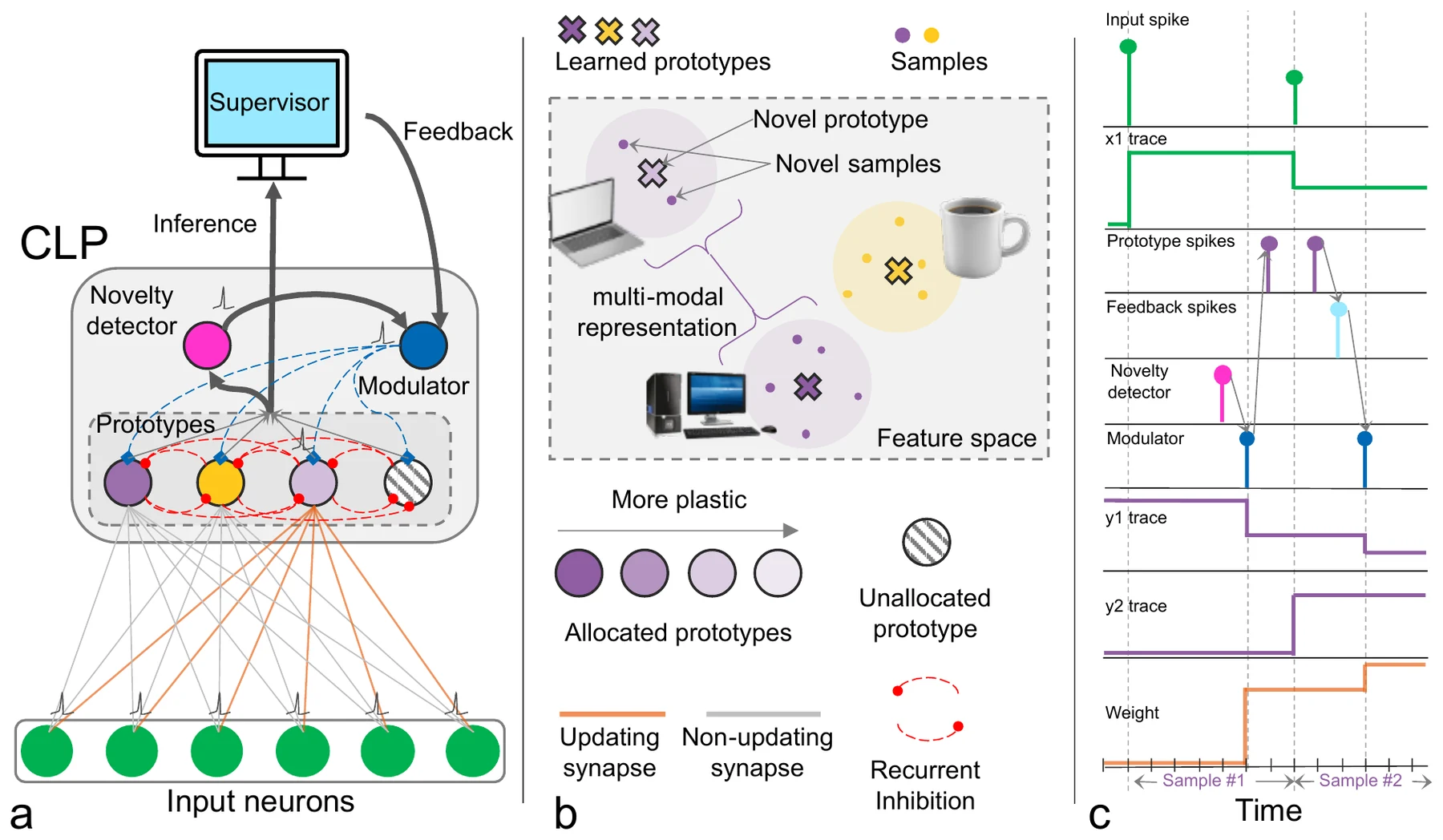
Problem
Edge devices need to learn new classes from a data stream without forgetting old ones, within a tight power budget. Most continual learners depend on replay buffers and backpropagation, which are expensive on the device.
Approach
I recast the CLP algorithm as an event-driven spiking network: a local self-normalizing learning rule, novelty-triggered prototype allocation and reward-gated metaplasticity, with INT8 weight and activation quantization. The result is the first online continual learner on Loihi 2.
Evaluation
Few-shot online continual learning on OpenLORIS against Replay, SLDA and other baselines. Latency and energy were measured on Loihi 2, on a Jetson Orin Nano, and for the same algorithm on CPU and GPU.
Result
0.33 ms and 0.05 mJ per prediction-and-update step: 7.3× lower latency and 341× lower energy than Replay on the Jetson Orin Nano, matching its accuracy at 1-shot and within 1.6 points at 25-shot. Against the same algorithm on CPU and GPU, energy is 70–183× lower.
Takeaway
The largest savings came from reshaping the learning algorithm for the hardware (local, event-driven, low-precision updates), and they only became convincing once measured on the device against strong baselines.
Paper
Online Continual Learning on Intel Loihi 2 via a Co-designed Spiking Neural Network
Nature Machine Intelligence 2026 · under revision