CLP: Continually Learning Prototypes
A prototype-based online learner for robots that meet new objects after deployment: it learns from few labels, detects novel objects and keeps learning them without supervision, with no replay buffer.
- 85%less catastrophic forgetting
- 99%base-class accuracy in the open world
- 65 / 76%novel-class accuracy (5 / 10-shot), learned without labels
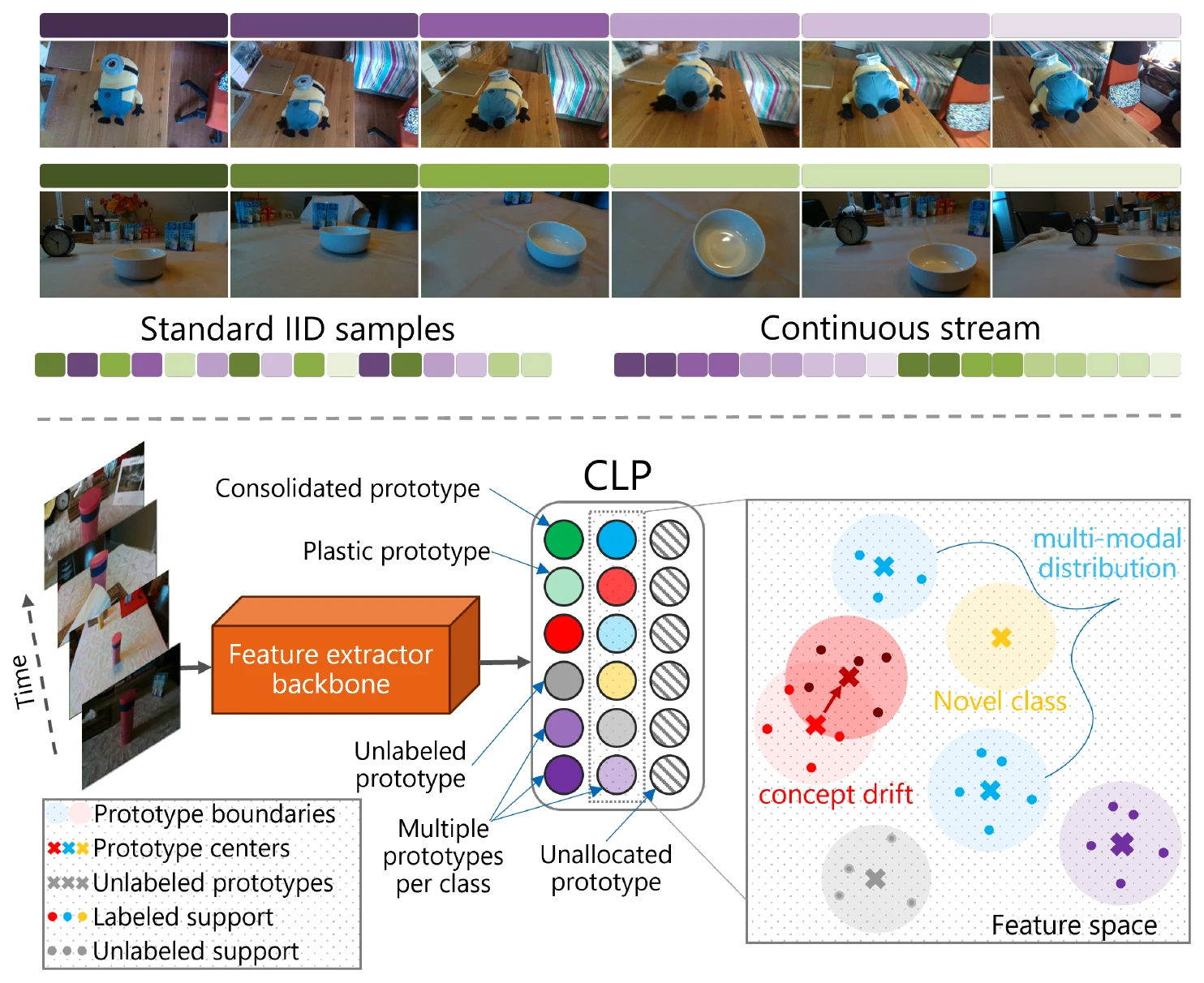
Problem
A deployed robot sees objects as a correlated stream, few of them labeled, with new classes and concept drift. Most existing continual-learning methods need buffering and balanced replay of training data, which does not suit this setting.
Approach
A rehearsal-free, prototype-based online learner on pretrained CNN / ViT representations: few-shot and semi-supervised updates, novelty detection, and new prototypes for novel inputs. A metaplasticity mechanism adapts the learning rate per prototype to limit forgetting. I optimized the algorithm with evolutionary search over discrete learning-rule components.
Evaluation
OpenLORIS, in class-incremental, few-shot online and open-world settings.
Result
85% reduction in catastrophic forgetting in dynamic environments and state-of-the-art results in the low-instance few-shot online setting. In the open world, CLP detects novelties with higher precision and recall than the baselines and learns the new classes without supervision: 99% base-class and 65% / 76% (5-shot / 10-shot) novel-class accuracy.
Paper
Continual Learning for Autonomous Robots: A Prototype-based Approach
IROS 2024