Interactive continual learning for robots: a neuromorphic approach
A spiking network on Intel Loihi that learns new objects in a short interactive session with a user, with a neural state machine deciding on-chip when and how to learn.
- 96.6%test accuracy, 8 objects × 8 views
- up to 300×energy efficiency vs. other online learners
Problem
A robot has to recognize particular object instances across viewing angles, poses and lighting, learn new ones quickly in an interactive session with a user, and stay open to later correction. Deep networks trained with slow, gradient-based backpropagation fit this poorly.
Approach
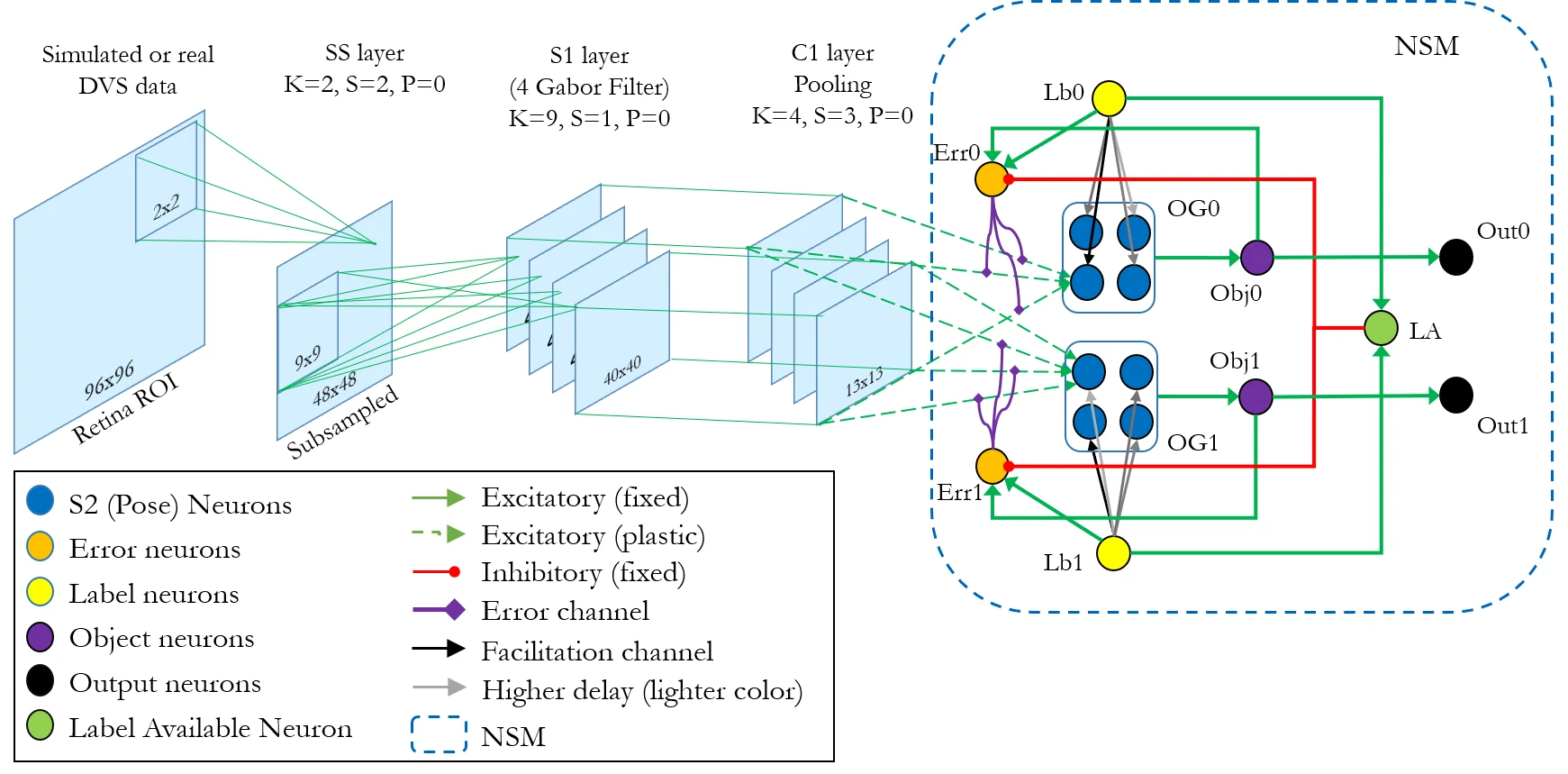
A small spiking network: fixed feature extraction (subsampling, Gabor filtering, pooling) and a single plastic layer of prototype neurons organized into object groups. A neuronal state machine regulates learning through label and error neurons, so allocation of new prototypes, merging of new views into existing ones and punishment of wrong responses all run on-chip with local learning rules, without switching the system between training and inference modes.
Evaluation
Interactive, on-demand learning experiments on a custom event-camera dataset generated in a simulated 3D environment, with the network running on Intel Loihi.
Result
96.55 ± 2.02% test accuracy on sets of 8 objects with 8 views each, and up to 300× better energy efficiency than other online learning methods at better or equal latency. The paper received the Best Paper Award at ICONS 2022.
Paper
Interactive Continual Learning for Robots: A Neuromorphic Approach
ICONS 2022 · Best Paper Award